Follow The Beginning Farmer's Wife on Facebook for additional personal peeks at building a family farm.

(Be sure to click both the Facebook "like" and "follow" buttons to not miss any posts.)

Showing posts with label Crooked Gap Farm. Show all posts

Saturday, October 17, 2020

2020: Where are we now?

The Beginning Farmer Show Podcast and YouTube Vlog!

It has been a LONG time since I've posted last, and almost as long since I've even signed on here. 

Honestly, I miss documenting what we've been up to, miss the community and encouragement from all who comment, and miss looking back over where we have been. 

Even so, I was starting to miss greater things with keeping up my blog. We now have 6 children, and I was missing time with them - which led me to slowly and eventually fade off of blogging. I don't plan to start back up anytime soon, (although I would be thrilled to find the day had an extra hour reserved for me to do just that!), but I did want to provide a quick update for those who started this journey with us, before we had even moved out of town.

Currently, we are still continuing our farm and are about to start our 12th year. Our 4 sons and 2 daughters,  ages 2 -16, bless us with a richness that far outweighs the slower pace of farm progress that happens with a young family of 8. I continue to homeschool all of the children as well as produce and preserve the vast majority of what we eat throughout the year. (Usually 500 quarts are canned in addition to the freezer and storm shelter being filled.) Ethan continues to work as a pastor in town to provide for our living expenses while the farm income is devoted to continuing to set up our farm. He also does his best to keep sharing our journey, knowing how helpful resources have been to him as we have started up our beginning farming journey. 

Recently, Ethan started documenting what is going on here on again on his YouTube channel and has been consistently sharing a number of videos each week. 


He has also produced over 150 podcast episodes since 2013. 


I am thankful that he has been able to keep up with documenting our journey, and am glad to have our journey pieced together for sharing with the generations down the road. I also hope that it is helpful and an encouragement for anyone else out there who might be starting or considering to start a beginning farming journey of their own. Thanks for joining along with us!

Thursday, June 5, 2014

Guinea Keets are Hatched!


These past few days my first batch of guinea keets have been hatching.  It has been a rather strange hatch, since one hatched on Monday, Tuesday the majority hatched, Wednesday a few more, and this afternoon (Thursday) I found another egg that has just started pipping. Considering I set them all the same day in the same incubator, I have been a bit confused at the spread of the hatch, but I'll take it.

Tonight I pulled the eggs from the incubator that did not show any signs of development, using a flashlight shining through to illuminate the egg. Normally, I would have done this before I put them into the hatcher (a few days before the hatch), but because there were eggs starting to pip through early, I just wanted to get them in the hatcher.

So for my counting and math - I set 150 eggs, 45 did not show signs of development, and only a handful of the unhatched eggs left did show development to some degree. These appeared to have stopped developing partway through though. I had 92 chicks hatch, giving me a hatch rate of 87%.  (If you are observant, you may have caught that 2 of the keets are a different color too.)

I'm pretty happy with the hatch rate, a little disappointed with the number of undeveloped eggs.  We keep a rooster to hen ratio of about 1:5.  Considering these guineas are not enclosed by any means, maybe that ratio needs to change a bit.  I also held onto the eggs approximately 5 weeks before putting them into the incubator, which could have been a bit long to collect and hold onto them.

If you remember in my previous post, I was unsure of if my guineas would continue laying after I set this batch, as I was having trouble finding more eggs.

Well, they hadn't.  They just changed locations. 

While I was in the garden one afternoon, I heard a few guineas across the road and in some trees by the ditch.  I had heard them here a few times so I decided to take a little walk. 

A wonderful thing happens when the grass gets taller.  You can see the guinea highways. It is hard to tell from this picture, but they trample down a path through the tall grasses on their most frequently traveled routes.  If you look carefully, you should be able to find this route by the grass seed heads that cannot be seen, as they have been laid down.

I hopped on this guinea freeway, and it quickly led me to a new stash of eggs, which held over 60.  It didn't take me long to have a new batch of over 150 eggs collected to put into the incubator, which were all under 3 weeks old when I put them in.  (If I wasn't so far behind this spring, I would search to see if I could find another nest, but this one will do for now.)

I asked Ethan just how many guineas he wanted me to hatch this year, and it looks like I will continue collecting eggs!

Follow The Beginning Farmer's Wife on Facebook for additional personal peeks at building a family farm.  (Be sure to click both the "like" and "follow" buttons.)

Tuesday, May 20, 2014

Gobs of Guineas

This is our third year with guineas on the farm.  Last fall someone described their “buck-wheat” call as a rusty gate continuously swinging.

I think they were fairly accurate.  

Even with this continuous clatter, we now have over 100 guineas on the farm. Hopefully that will soon turn into over 200.

The reason I even sought after guineas in the first place was because of their reputation for destroying tick populations. When we bought our property, our 23ish acres of pasture had been in a CRP planting of prairie grasses for well over 10 years.  As we soon found out, the ticks had used every opportunity they could to reproduce in these tall grasses.

Just before a trip into the doctor, to get a large rash checked out where my young daughter had just had one of her many tick bites of the year, I posted a quick post on Facebook searching for someone who might have some guineas.

As the Lord’s provision would have it, on our way back from the doctor’s office, I noticed someone on the way home had some guineas wandering in his yard, which I had never noticed before. I immediately pulled into his driveway and asked if he had any for sale.

He didn’t, but he did have a pile of eggs he told me I could just have to try to hatch out.  While visiting, I also learned that he was the gentleman who had sold us our land, and that he would be more than happy to buy it back from us as land prices shot up shortly after we bought it. Although I didn’t offer him the land, I did thank him for the guinea eggs.

 As I incubated the eggs for my anticipated tick control, I did a bit of research on guineas and found they are also wonderful to have in gardens, as they are high protein feeders ravaging insects.  They also do not scratch like chickens or  dine on the produce – a perfect pest control companion for the home garden.

Later that fall, after the keets had hatched and grown a bit, we were asked if we were raising them for meat. We had never considered it, but with a little more research I found out that guinea fowl is actually a specialty meat – often used in high end restaurants as their game bird. 

It just so happened that the guinea keets we were raising were a jumbo version, and the jumbo version that naturally reproduce vs. the jumbo version that needed to be artificially inseminated.  Perfect for tick control, garden pest control, and another meat enterprise.

 Which leads us back to the 200 guineas we hope to have later this year.  Last year we raised around 75 of these birds, keeping back a breeding flock of 25.  And although we did order some keets in that “may” reproduce on their own to get some early guinea meat, we hope to hatch out many of our own.

The thing about guinea fowl is that they do not lay in nest boxes like chickens do.  Instead, they take great pleasure in hiding their eggs in tall grasses.  Along with that, they are awful caretakers of their keets.  The “gather the young under their wings” does not apply to guineas, and many of their keets are often overcome by the elements or just plain lost. Because of this, I have been busy collecting/searching out guinea nests to incubate and hatch more of our own flock. 

Thankfully, guineas do like to cluster together to hide their nests.  Most of the year they run around in one big pack scaring up insects into the air to gobble them up. During spring, however, I have found they break apart into groups of about 6 or so with a male to accompany them.  This group will lay their eggs in one spot, making a large cluster of eggs in a couple days. 

Before they started laying, I set up a trap nesting spot with hay bales stacked to make a little cave.  When I found an egg in this nest, my search began. This spot has also by far been my most productive nest, and I should have made more in various locations around the farm.

So this spring, when it was just too wet to garden or when I needed to get outside but didn't feel quite well enough to garden, I took some walks to look for guinea eggs.

I found one of these nests on the far corner of the farm while checking on the electric fence. I just happened to scare a guinea up off the nest or I may have missed this one.

Another nest I went searching for, as I knew that there was a group of birds hanging out in this area. This nest was made in a tent like structure of weeds, and I’m sure I would not have found it if I wasn’t intently searching for it.


A third nest was found again in an area where I had seen guineas gather, but I didn’t have to search as hard as I came across it when a guinea was on it, scaring her up again. This nest seemed to be popular as there was a trail of eggs around the next from guineas most likely waiting their turn!
It didn’t take me long to get 150 eggs to set in our incubator, and I have another 50 or so waiting to go in when these hatch, not because I am waiting on the room but so that we can space out our available meat.

Unfortunately, my guinea nests have dried up this last week or so. I know a predator found the location of one nest as evidenced by some egg shells, but I’m wondering if they have just slowed down on laying since my trap nest has even slowly dwindled down. Or they are just getting smart, and I need to do some more searching for nests, although I have gone on a couple morning walks and have not scared up any guineas in the ditches lately.

In a couple of weeks, however, we’ll see just how well these guinea eggs were fertilized this year, and we’ll see how this year of focused guinea raising goes. We have a few kinks to work out, such as corralling these flighty birds to keep them where we would like them and catching them during processing time. We do have some different plans of attacks for the year including sending off the year old guineas who have taken to wandering a bit more than we would like and roosting in the rafters, setting up a roosting area where we can shut the door and actually catch them, as well as some ideas to keep them in the pasture area more.


I’m not sure if guineas will be a permanent part of our farm or a “It was fun while it lasted” part of the farm. Even with the challenges of these skiddish wandering foragers and the times of unwanted, not-stop rusty gate noise, they do provide wonderful pest control, a unique meat, and quite a great deal of entertainment as they charge though the pasture in mass, scaring an array of insects into the air, and darting around to gobble them up.

Do you have any experience with guinea fowl? If so, I'd love to have you share!


Follow The Beginning Farmer's Wife on Facebook for additional personal peeks at building a family farm.  (Be sure to click both the "like" and "follow" buttons.)


Wednesday, April 23, 2014

Cancel School - It's Time to Plant!

As I have been trying to balance getting enough rest this trimester, keeping the kids' school moving along, helping Ethan with the farm/marketing as I can, and just managing family life, I have let some prime garden planting days pass by.

Last weekend, after a string of these nice days, we received about 4 inches of rain which made the garden quite muddy. Over the last couple days the garden has been slowly drying, but the forecast this morning showed rain coming around noon - with more rain to follow again this week.


Upon seeing this when I woke I decided that even if we had to tack on another school day to the end of our school year, I was rounding up my troops to plant as much as I could in my garden which has been calling for spring attention.

Even though I had tilled up the entire garden a little over a week ago, I pulled out the tiller to fluff up the soil in the rows that I was able to mark last night.  Some might say this extra tilling is a silly step, but I have found that when dealing with a garden my size I would much rather hoe through powdery soil when I plant.  It might take slightly more time re-tilling planting rows, but it ends up taking significantly less effort.

While I was tilling up the rows, I had the kids gather the sprouting potatoes from our cellar that I had cut last night in hopes of planting this week.  Each potato is cut in two or three portions, making sure at least 2 eyes are on each portion.  They are then set aside to callous over.  This step prevents disease from entering the potato.  Although I should have let mine sit a day or so longer, I decided this morning to take a chance since it might be now or never (or at least a few weeks more).

Once the paths were tilled, I stretched out my line (gotta love having extra stick in fence posts and reels of poly wire free!), started making the trenches for the potatoes and path for the peas with my hoe, and called in my crew who were all excited to help as they grasped the value of our garden from the produce we have been enjoying since last gardening season.


Caleb, who just turned 10 last week, was busy planting peas along the outer fence line using a milk cap I gave him to get the spacing I desired.

Caleb has learned the importance of these peas since I don't let my kids just wander and graze through the garden yet, mostly because of the excited little feet that forget to watch where they are stepping (although the kids do get to enjoy grazing some if they have come in to help.) These fence line peas, along with a couple fence line cherry tomatoes, are free for the taking when they are out playing.


After a quick lesson on positioning potatoes and being careful of the already forming sprouts, Isaac (5) and Hannah (8) helped me fill 4 rows of potatoes using sticks for a spacers that I had broken to just the right length. Jonathan (3) was Hannah's runner, bringing her potatoes down the row to plant as she zipped along.

As you can see, it wasn't the beautiful 70/80 degree sunny days that I missed out on last week, but it was temporarily dry.

Around 10:30 Ethan arrived back home with 2 lamb and 3 hogs from the locker. We quickly covered our 4 rows of potatoes and row of fence line peas so that I could help inventory the new meat.  Caleb and Hannah set to work on their math while Isaac and Jonathan played on Starfall, a wonderful online early literacy site that they get to enjoy during the random school times when Ethan needs my help.

Around noon the meat was inventoried and the rain began.  I still have 2 more rows of potatoes to put in, another area of peas, and some onions, greens, carrots, broccoli, and cauliflower that I would like to get caught up on, but I am happy that we were able to at least get a start.

If I'm feeling well enough, we'll also try to plug away at some more school tonight (the older two continue with scheduled independent school in the afternoons while the younger rest) and maybe avoid that extra day at the end of our year. :)

Follow The Beginning Farmer's Wife on Facebook for additional personal peeks at building a family farm.


Tools of My Trade
This book is a wonderful resource on companion planting in order to grow foods without the use of chemicals. It details good and bad companions, how various plants work together for increased flavor, productivity, and pest control.  It includes information not only for the vegetable garden, but also for companion planting with fruits, nut trees, ornamental plants, and much more. Copies of this book can be found used or you can purchase a new copy from the link provided.

This book is a wonderful resource on the technical aspects of seed saving.  It shares about the heritage and classifications of different garden seeds (heirlooms, hybrids, etc) and how the different types of seeds react to seed saving.  It shares about how to effectively maintain pure varieties of seeds with respect to how the plant pollinates and through different seed saving techniques.  Seed clean and storage techniques are also described.  A large portion of the book is given to explaining each type of vegetable family, the classifications of families to avoid cross pollination, and how each vegetable family responds to seed saving and storing.  If you are interested in saving and keeping your own pure strains of seeds, this is a must have book!

Tuesday, December 3, 2013

A Hoop House Sneak Peak

Our hoop house posts are in! 

If you haven't heard of our hoop house project, you can check it out at http://crookedgapfarmhoophouse.com

We are so excited to have gotten the posts in before the ground completely froze.  Now we can finish up phase 1 of our project this year, which will include putting on the hoop and moving in the pigs! (Next year we hope to complete our project with electrical and cement work.)

A more detailed account of our hoop house construction will be posted in the future, but here are a couple sneak peaks as our kids' helped along. Our pace does slow a little bit with the extra help around, but the investment in our children far outweighs cutting out a few hours of construction.

Our 9 year old watches on as we work to square up the building.  Earlier in the day he had a quick lesson about the pythagorean theorem. 

Our then 7 year old helping lay out the steaks for the line posts.

The crew watches on as the first corner post is drilled.

Our 2 year old gives the hole his approval.

Our 2 and then 4 year old watch on as spikes are pounded into each post to help grab the concrete.

Taking a loader break. The kids have learned well from their grandpa who has taught them all about the John Deere union bell.

Our 2 year old watches on as Ethan straightens one of the holes due to some challenges with dull drill blades and hard packed clay.

Our 2 year old back filling some post holes after the quick crete has set.

This soil has to be tamped, of course to hold the post tightly.

Our now 5 year old helps out with the tamping as well.

Our now 8 year old also joins in the tamping.

All of the posts are in!  Our 9 year old helps measure to find out where to set the laser level. Today posts were marked and are ready for trimming down in order to receive the hoop house hoops!

We are so relieved to be at this point, and we are blessed to be able to have our children join with us in our journey.

Follow The Beginning Farmer's Wife on Facebook for additional personal peeks at building a family farm.

Monday, November 11, 2013

To Roll Out a Pie Crust

Two Saturdays ago we had our first major event (besides the Farm Crawl) on our farm, the Crooked Gap Farm "How Do They Do That" Class.  Our guests arrived at 9:00 a.m. and stayed until around 8:00 p.m.  It was a day full of tours, questions and answers, marketing discussions, and our insights on the mix of family, farming, and finances.

It was also a day full of Crooked Gap Farm food!

After I finished teaching school to our kids for the day, I spent the week before the event planning and preparing food for the 14 terrific individuals who were our guests, along with our family of 6.

Our Lunch was:
  • CGF pulled pork sandwiches (on store bought buns)
  • CGF tomatoes for the sandwiches
  • CGF canned pickled banana peppers for the sandwiches
  • CGF boiled potatoes, containing 3 different varieties of potatoes
  • CGF buttercup squash
  • CGF fresh cut carrots 
  • CGF watermelon
  • Harvest Cookies containing a CGF heirloom pink banana pie squash and CGF "Run of the Farm" eggs
(Thanks to Diana, from My Humble Kitchen, for the photo!)

Our Supper was:
  • CGF Beef and Vegetable Soup with the following ingredients from our farm : our heritage grass-fed Dexter beef, beef broth, carrots, onions, potatoes, summer squash, green beans, yellow wax beans, and sweet corn.
  • CGF cut carrots
  • Homemade rolls, made with CGF home rendered lard
  • Strawberry Rhubarb Crisp made with CGF strawberries and CGF rhubarb
  • "Pumpkin" pie, made with a CGF heirloom pink banana pie squash and CGF "Run of the Farm" eggs, as well as the pie crust being made with our CGF home rendered lard.

Over the summer I have tried to involve my kids in as much of our food preparation and preservation as possible, and this week of preparing for our class was going to be a very full week of cooking.  I soon realized that that a lot of what I was cooking involved knives, cutting, and chopping, and I was having a hard time trying to figure out how to involve the kids rather than keep shuffling them away from my sharps. 

One afternoon during the kids' rest and independent time, however, was my pie making afternoon.  It was the perfect opportunity for me to teach some pie making skills to our 7 year old daughter so I pulled her away from her independent activities and had her come out to the kitchen.

One of the things that I tell my kids is that if you want to learn how to do something, watch first.  After you have watched the process, ask any questions you have bouncing around in your head.  Once you have done that, you may try it out.

I had 3 of my pumpkin pies to make so while I was mixing the dough, rolling out each crust, placing them in their pans, and putting on the finishing touches, Hannah watched on.  I could tell how eagerly she wanted to help me with the pies, but she patiently watched as I finished up the first, and then the second, and then the third.

After I was completed, I balled up my remaining pie dough and told her it was her turn, much to her surprise.

I have a little six inch diameter pie glass that isn't good for much besides making mini pies with leftover pie dough.  But, when you have a daughter, that reason is enough!

After all, my grandma taught my mom how to make pie crusts.  My mom in turn taught me, which led to me winning 3 champion trophies when I entered my pies in the pie baking contests during my 4-H years. I still use that same recipe (which can be found on our farm's recipe blog), and I hope that Hannah will some day pass it down as well.

So after finishing my three pies, I began my kitchen clean up and let Hannah work on her pie crust all by herself.  The only thing I helped her with was forming the ball of dough into a disk.  She tried, but it took a little more muscle than she could muster. After that first step, I continued to clean up around the kitchen, pausing long enough to snap some pictures of her work.

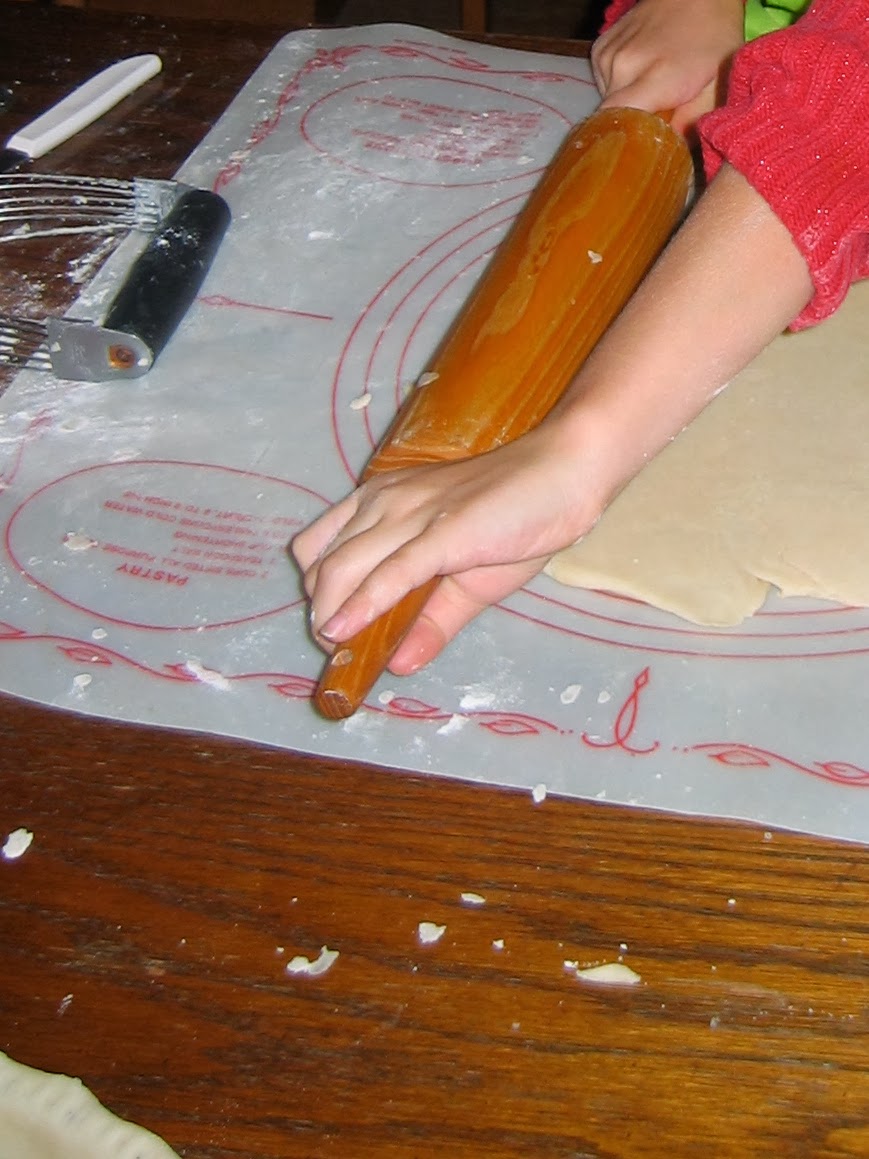
Hannah paid careful attention to the dough as she rolled it out, being sure to keep her pie mat and rolling pin dusted just enough that it wouldn't stick to the mat or the rolling pin, rolling it out easily and gently.  She did a good job not getting too much flour out either too, which would dry out the dough.

As Hannah rolled out her dough, she tested the size of her crust by carefully holding her pie glass upside down, looking for an extra couple inches of dough all around the glass.

Each time the pie dough wasn't wide enough, she worked the wider and thicker portion of the dough to the narrower portion.  She was careful to roll from the center of her pie dough so that she wouldn't pull up and tear the edges of her pie crust.

Once her crust was wide enough, she carefully folded it in half and scooted her pie dish underneath.

After the pie dough was reopened onto the pie dish, she carefully lifted up the outside edges of the pie dough in order to drop the dough down into the pie dish.  This lifting and dropping prevents the dough from being stretched or torn while it is being fitted to the pie dish.

Hannah then completed her final step of making her pie crust by pinching up around the dough around the outside of the pie dish and then trimming off the excess.

As you can see, there will still be a bit of pie dough scraps.  These scraps are perfect for rolling out again to be cut into pie crust cookies, which can be brushed with milk and sprinkled with cinnamon and sugar.  They are yummy to eat on their own or can be used to decorate your pies, as I did with my "pumpkin" pie.

As we talked about in our farm class, there are a lot of sacrifices that come with starting up a farm, especially when you are raising a family.  Days are full, bank accounts often aren't. It is hard to find time to get away as a family, and if that time was there, well . . . the money to do so might not be.

It is a choice that we have made.

I have also made the choice that I'm going to be purposeful in including our kids as we go through our days: To let them tag along beside us with our guests during our farm classes, even though it would be much easier on me to send them to a friends house.  To plant a couple extra cherry tomatoes plants in the garden, reserved for helping hands to snack from. And to make sure I plan my recipe to have enough pie dough for one last pie, a pie carefully formed by little hands in my small pie dish which I keep around for one purpose only.

Follow The Beginning Farmer's Wife on Facebook for additional personal peeks at building a family farm.

Tools of My Trade

 Linked is a set of 2 simple yet functional 6 inch pie plates dishes, perfect for daughters, granddaughters, or for making 2 smaller pies from one recipe. You also might be able to find some little 6 inch pie dishes at garage sales or second hand stores.

Although my particular pastry mat seems to be vintage now, there are many other pastry mats out there, sometimes even found at garage sales. The circles on the mat can be used as a guide for rolling out your dough the right size, but my favorite use for them is to contain my flour mess.  Cleaning is so much simpler when you can lift up your mat, dump excess flour into the trash, wash off anything that remains in the sink, and then finish your clean up with just a swipe or two of the dish rag across the table, creating no gummy messes.!

Sunday, November 3, 2013

Repurposing

repurposing :  to give a new purpose or use to 

There's a lot of repurposing that goes on around our farm.  We repurpose materials, structures, livestock areas . . .

There is also a lot of repurposing that goes on in the house. I also repurpose materials and storage spaces, as well as our motivations and time spent doing things.


I have decided that it is time to repurpose my blog.

My blog has slowed down, halted, and became virtually silent as we transitioned from our start up of the farm into our actual farming.  Some of this has been due to the addition of more little blessings running around the house.  Some of it has been due to the swelling of demands to keep a beginning farm up and running.  Some of it has just been due to a lack of purpose in my posts.

Sure, I have always wanted to keep a journal of our journey.  But the lack of purpose of keeping that journal started to creep in.  

Even so, I have continued to want to find some way to continue my blog. Not just for the readers who may be out there, but for our generations to follow . . . to see how we persevered with where we felt called, to see how the Lord provided for where He had us, and to know the history behind our farm. (All assuming the farm continues on - as well as Blogger!)


Yesterday we gave an in depth tour of our farm to 14 individuals.  They arrived at 9:00 am.  We combed the farm viewing the different enterprises, discussing how and why we do things the way we do, shared how we attempt to balance family, farm, and town jobs, discussed finances, and ate a lunch and supper of Crooked Gap Farm produce and meats that I had spent the week preparing.  Our guests left around 8:00 pm and left me with a desire to repurpose my blog.


Over the last year I have had numerous individuals asking me how I manage the home, the garden, the family, and even the farm in my role as a stay at home, homeschooling, farming wife and mom.  Many have asked (and re-asked) for classes on some of the thing I do. I would LOVE to hold these classes and share the things that I have discovered from my journey of cooking with a box of Kraft Macaroni and Cheese in town to preparing 2 meals for 14 guests and our family of 6 with foods almost completely raised and grown on our farm.

The wall I run into is lack of time. And lack of facilities. And lack of supervision for our children. (Ethan has been working ~60 hours/ week of off the farm work, along the daily chores and 6 months of Saturday farmer's markets . . . and all else that goes along with keeping a farm business running.) 


Which brings me to my next thought.  Children. I have had a number of conversations lately about how to make family work with starting a farm. A wise friend shared with me a couple years back that our culture spends so much time following our children around (not that it's wrong to join in their interests) and so little time having our children follow us around.  Following us to learn from us, to see the beauty in what we have learned to hold beauty, to encourage them, to share with them, to shower love upon them.


In Titus 2:3-5 we are encouraged to
"Similarly, teach the older women to live in a way that honors God. They must not slander others or be heavy drinkers, Instead, they should teach others what is good. These older women must train the younger women to love their husbands and their children, to live wisely and be pure, to work in their homes, to do good, and to be submissive to their husbands. Then they will not bring shame on the word of God." 

These conversations with my farm friends looking for help on how to provide for their home, my personal friend who encouraged me that it was okay that we couldn't join in the American chase with our children, and my Heavenly Friend who continually shows me the way to fullness of life, have all brought me to repurposing my blog. 


I still hope it to be a journal throughout our farm journey, but as I do this I hope it to be an opportunity to share with others how to love their husbands and children, to live wisely and be pure, to work in their homes . . . all the while challenging myself and encouraging my readers to bring the next generation along with them so that they can do the same. 

Wednesday, July 31, 2013

Name that Grass - Round 1

Okay all of you homesteaders and farmers out there.  Here's a little challenge for you.  I went on a walk with my kiddos last night and brought back seed heads from some of the grasses along the way.  We are going to try to identify them, learn their names, and hopefully learn some facts about them. 

I realize it helps to know their height and see their leaves, but how can you do on naming them, going from left to right?  As of tonight, I'm certain of 2, fairly confident of 3, and have some ideas for 2 others.  

You can click on the photo to see it larger. Feel free to leave a comment here on on my original post on Facebook with your guesses or expert answers! 

And for being a blog reader, I'll give you some insider information.  These grasses were collected on the part of the pasture that has not been heavily over seeded by us. It had been in the CRP program for 10 years and had been planted with native prairie grasses.  The area includes high and dry land as well as land that stays fairly moist from a small spring and runoff from rains. Round 2, which will be coming soon, will have more grasses from the area that we have over seeded.

Have fun! :)

p.s.  Sorry, there is no prize but the satisfaction of knowing that you know your grasses.

Thursday, March 14, 2013

The Beginning Farmer Show - New from the Beginning Farmer!

I can't tell you the number of days I think of things I would like to blog about, photos I would like to take and post, stories I would love to share.  Awhile back, however, when I told my kids "Just a minute, Mommy is busy," one too many times while writing a blog post, I decided that blogging would need to wait until the kids were in bed and the house/farm work is done for the day (to avoid the same phrase the next day while catching up on dishes or laundry due to blogging in the evening.)

As you can see from my lack of posts . . . my days are full.

I wanted to take a quick break tonight, though, as a birthday present to Ethan (his birthday is today!), to share about a new farm project he has going on - his podcast called The Beginning Farmer Show. You can see his first post, copied and pasted below, or head over to his blog and view and listen to them both.

Enjoy!


The Very First Episode of The Beginning Farmer Show!

This is something that I have wanted to do for over a year now, but never had the guts to go out and accomplish it. I thought about it ... planned for it ... gathered the equipment to do it ... and finally just as I did with farming ... I had to just get out there and do it! With all of that being said, I'm not completely pleased with this very first episode and realize that I need to work on my audio quality, iTunes integration, feeds, and so much more. I am glad to have at least one episode out there though ...

On this very first episode of The Beginning Farmer Show I share a quick update on how the farm (and myself) has handled the winter so far. It has been a winter that hasn't gone exactly as planned and I'm sure I'll be playing catch up because of that this spring. After the quick Crooked Gap Farm update I dive right into a discussion of Heritage Breed Livestock and why I believe they work for my farm, but how they may not be exactly right for your farm ... that is a decision that you will have to make.

The Beginning Farmer ShowFinally, there are many lessons that I have learned since we began the farm almost five years ago and I want to share some of those lessons with everyone in hopes that they don't make the same mistakes. This weeks "Hard Lesson Learned" actually goes hand in hand with my main topic of Heritage Breed Livestock as I talk about some of the mistakes I made in purchasing some of the initial stock for the farm.

If you are interested in learning more about Rare or Heritage Breed Livestock please check out The American Livestock Breeds Conservancy. As always you can follow along with The Beginning Farmer and Crooked Gap Farm by checking out these links ...

I would love to have you interact with the The Beginning Farmer Show. Feel free to comment on this post with your suggestions, questions, ideas, or even podcasting tips! You can also always reach The Beginning Farmer through e-mail.

P.S. If you know about podcasting, Feedburner feeds, and all of that good stuff I would love to hear from someone about why two posts that contain links to .pdf's are showing up in my subscription to the show. It is very frustrating to me!

Thursday, November 22, 2012

Thanksgiving Thankfulness from the Farmer's Wife

Every year we have so much to be thankful for, and every year that we are able to continue farming is counted as a blessing - this year especially.

At the beginning of the year we were having to take a good hard look at the logistics of even being able to stay on our farm.  Ethan had a transition in his town work and had been working retail for a year.  It became apparent, however, that his retail job was not a job that would fit with keeping the farm going.  After many long discussions, we decided to be open to the possibility of a move for Ethan to be involved in a ministry job. And so the applications started going out and the interviews started, up to 2 hours away from our farm - which of course would mean selling the farm.

Right as we were in this process, however, Ethan was approached out of the blue by a church within our town.  Ethan met with the leaders of this church to find out what their vision was as they were wanting to learn more about what Ethan's ministry passions were.  Before we knew it, Ethan was offered a full time position, which he started within a month. Not only did this offer allow Ethan to follow his call to ministry, but it also allowed us to keep the farm.

I was amazed and humbled with the timing of this job.  It started the same week that our Downtown Des Moines Farmers' Market started. To be perfectly honest, I was a little worried (read very panicy) as to how farming/farmers' market season/retail job would work for our family.  After 10 weeks of Ethan's new job, I had learned that I really shouldn't have spent so much time worrying.

And then it happened.  One fateful evening at our homeschool softball game, an evening I had stayed at home with the kids for some reason, Ethan tore his achilles tendon. (He did make the out though!) As we sat in the ER trying to process the injury, the questions popped up once more (as they have multiple times, yearly, since we started the farm).  Do we keep going?  Do we sell the animals and keep the land?  Do we just sell it all, buy a small acreage in the country, and become a boating/fishing family once more? 

Thankfully, my good friend, who had driven Ethan to the ER where I would meet up with him, looked me in the eyes and told me not to worry - people would rally behind us and help us get through.  And that is just what happened.

Ethan ended up in a splint for 3 weeks, followed by surgery and a cast for 6 weeks, followed by a walking boot another 3 weeks.  After developing planter faciatis, he was taken out of his walking boot to start physical therapy (which he continues).  I won't lie and say I was not frazzled, completely exhausted, and sometimes went a little nutso from taking over the farm work this summer, but I will say that the Lord provided for our needs.

We were never without family, homeschool friends, and church friends to help us out with things I couldn't get done myself - loading hogs and lamb for the locker, setting up new fence, doing improvements on the farm, manning the market booth when Ethan couldn't, etc.  I also had a meal a week provided to me once each week by my homeschool friends.  I can't say enough how I looked forward to that night of no cooking after early morning chores, hot afternoon chores (did I mention we had historic heat and drought this year), and after supper till the sun went down chores - all while trying to keep the housework up, garden growing, and husband and kids loved.

Ethan kept reminding me it was temporary.  And it was.  One day, shortly after the Farm Crawl (where 1000+ people visit our farm) and as homeschooling was starting, Ethan took over the chores again, be it ever so slowly and carefully. And then our 6 months of Saturday farmers' markets were over.  And now we are in a time of "rest" (for those who have town jobs and farm as we do, you know rest is said in relation to the rest of the year).

Today is Thanksgiving.  Each and every day I am thankful to the Lord for His sacrifice on the cross, which paid the penalty for my sins, and for His resurrection that promised life eternal to all who would follow Him . . . for His sacrifice and promise to me.

But today is a day where I also count my blessings from Him - for Ethan's new job which allowed us to keep the farm.  For family, friends, and our new church family who helped keep our farm afloat this year.  For our customers who cheered us on and blew us away with our best year yet and an increasing demand for our meat. And for what the farm has provided for our family - including the lessons learned.

It seems appropriate that this year is the first year we have had a Thanksgiving meal made completely with food from our farm.  I am reminded of the grace that was given this year to have a meal like this, in a year of drought and injury, and of the grace to be yet another year on the farm.

From our farm: sweet corn, broccoli, carrots, pickles (cucumber and dill), potatoes, sweet potatoes, heritage breed chicken, green beans, cooked carrots
Our sweet children, who were troopers this summer and helped me with growing, harvesting, and preserving each item above.


Follow The Beginning Farmer's Wife on Facebook for additional personal peeks at building a family farm.

Sunday, April 29, 2012

The 3rd Building on CGF Arrives!

As many of our blog followers might know, we purchased our farm about 4 years ago with absolutely nothing on it except trees, grasses, and massive ant hills. We have come along way since we first broke ground here, but we still have quite a bit of set up to do! 

One of the things that we are much in need of is more structures.  We have our house and our open face shed that we built, but that is it.  With all of our different livestock, we really would like more buildings.


About 1/2 mile away, on the top of the hill on an old farmstead, we saw this old 12 x 20 grain building.  We contacted the owners of the land, met with them and enjoyed hearing the history of the farmstead, and we were given permission to purchase and move the building.

Since it was built with 3 skids, which had been resting on concrete, it would have been a simple-ish task to move it to our property after a good snow, pulling it behind our tractor. But alas, we didn't have much snow this winter and it is now almost May.  So we did the next best thing. Ethan got ahold of his cousin, who also farms and can do about anything - and who has a grate trailer and an assortment of tractors, and requested some help.

I trailed behind with the camera to capture the process.  Here's my best attempt.
*You can click on the photos to enlarge them.


Ethan and Verne hooked up the front corners of the building with chains to the loaders of 2 4020 tractors.  They then lifted up the front of the building.


Verne backed the trailer under the building. (The trailer had some steel extensions on the bed so the skids would have support on them.)

Next, the building was hooked up to the winch.  This would have easily pulled the building up onto the trailer . . . except the winch wasn't getting power from the batteries or something.  I didn't ask!


So plan B - Pull both tractors parallel to the trailer, hook them up again to the corners of the building, and back the tractors up to pull the building onto the trailer.


 Now, the large, heavy building somewhat was on pivot point being pulled on different corners by 2 tractors.  All I will say is that it is a bit tricky to reverse at the same rate with 2 different tractors, and I was glad with the building was on the trailer and sitting still!


After the building was on the trailer, I had to take off to town with our kiddos for our home school coop.


Ethan said that they then chained the building to the trailer and headed down the road.


The 1/2 mile drive was uneventful, and they pulled up into our pasture behind the house.


Unloading the building seemed to be a bit easier, although pulling the building off with the tractor didn't seem to be the best way to go power wise.  They kept the tractor chained up, though, and just pulled the trailer ahead. The weight of the tractor seemed to do the trick as the trailer pulled ahead, and the building slid off the back.  Just before the last part of the building came off the trailer, they once again hooked the building up to both tractor loaders to hold it in the air while they finished pulling the trailer out, and then they gently lowered the end of the building to the ground.

So now we have another building here!  We have a bit of work to do before we use it though.  First off - we discovered that it came with honey bees in the walls! Thankfully we have a bee keeping friend who is excited to capture the colony for a hive.  We then need will need to reside it to keep it tight.  We need to make it predator safe since we plan on brooding some chicks in one of half of it. (There is a full wall in the middle, dividing the building in half.)  And lastly, before we pull it to its permanent location, we want to put some lengths of cement down to help it be level and stay off of the ground.  Since we will be putting a bit of work and some money into it, we want it to last a long time! 

So there you have it!  Hopefully I can get some pictures and posts of the bee extraction and fixing up of it. I'm sure excited to put it to use though!

Follow The Beginning Farmer's Wife on Facebook for additional personal peeks at building a family farm.
Related Posts Plugin for WordPress, Blogger...