Follow The Beginning Farmer's Wife on Facebook for additional personal peeks at building a family farm.

(Be sure to click both the Facebook "like" and "follow" buttons to not miss any posts.)

Saturday, May 31, 2014

Storm Shelter Blunders and Waiting Projects

We are now entering our 6th summer living on the farm.  Isaac, just like each of the other kids when they were born, accompanied a major life change. (Which makes me a bit curious to see what will happen with this baby!) We moved into our partially finished house on the farm in October of 2008, and Isaac was born in November.

I would think that after 5 full years of living on the farm, we would be a bit more settled in. With Ethan still working off of the farm, however, and with the kids at home and homeschooling, there is still much settling in to do.

If you would switch one of the above - either Ethan being on the farm full time or myself being on the farm without kids, I'm sure we would be settled in.  The fact is, starting up our farm would be impossible without Ethan working extra jobs, and we have kids.

I have had a number of young couples considering farming and family ask me if it is a good idea to start a farm and start a family at the same time or if it is a good idea to start a farm with a young family.

My response . . . it is hard.  It would be so much easier for me to not have children right now so I could be a better help to Ethan in our farm setup. Either I could go to work and provide more income to allow Ethan to be on the farm more, or I could do more of the farming. Everything would move along so much faster - getting settled in, getting the business established, and turning profits sooner. But I wouldn't trade our kids for any of that. They are a blessing, and they add richness, joy, and fullness to what we are doing. I can't imagine farming without them.

So with that introduction, here are some projects that I worked on today. Projects that I wish were further along then they were, in terms of weeks and years, but they aren't. Projects that I'm sure would be done if we didn't have kids or if I wasn't expecting, but projects that will get done in due time.

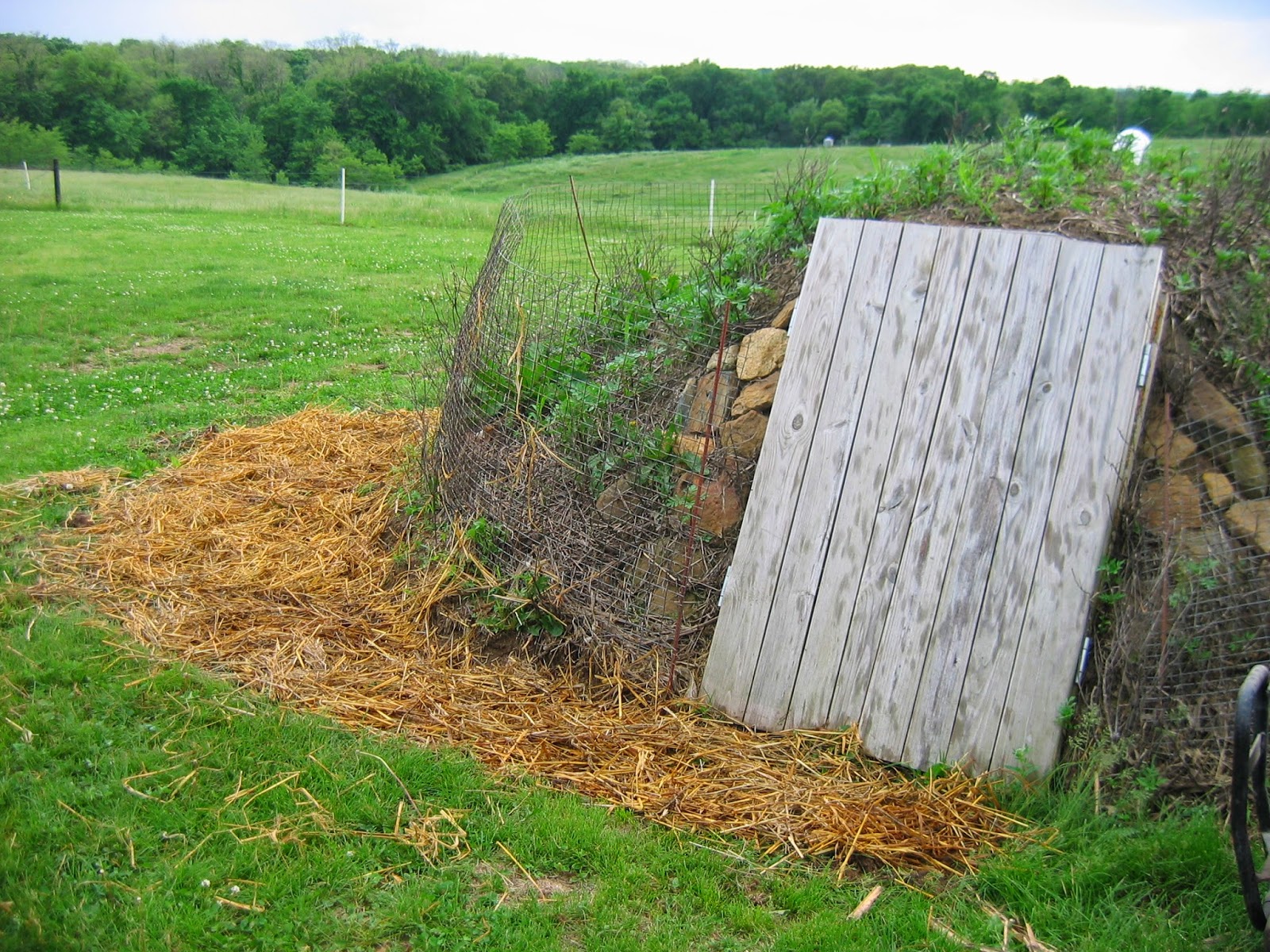
First off, the storm shelter. The picture below (sorry for the post in the middle) shows the dirt work around our storm shelter before last spring.  It was roughly done with a skid loader when they installed the shelter in 2010, and for 3 years after that it was used by any animals that made it to the yard (which the cows and sheep did often before we got our yard fence in) for king of the mountain.


The dirt work badly needed to be redone, not just for visual appeal and the ability to plant on it as I wanted, but also to keep the storm shelter insulated properly to be used as a root cellar.  It had been put on hold amidst our settling in for too long, so late last spring I spent 8-9 hours one day with a shovel on the storm shelter moving dirt and shaping the storm shelter mound.  I remember vividly because it was about 98 degrees that day and I ended up sick with mild heat stroke that evening. (Yes, having children slows me down, but I am also very stubborn when I want a project done badly enough.)

Even so, I got the project done.

Or so I thought . . . until this winter.

One day, after a thaw and refreeze, I went to go get some produce from the storm shelter, which was packed with potatoes, apples, carrots, and squash. 

I would soon discover that with the dirt work I had done the spring before, I had made the lowest part of the storm shelter's base right in front of the door. Perfect for melting snow to collect and refreeze into a solid chunk of ice, making it impossible to open the door.

Thankfully, Ethan came to my rescue a couple of times and chipped through inches of ice so that I could gather up a couple week's worth of produce to store in the house to be used, but with his full schedule of off farm work, I only asked this of him a few times.

So the majority of the winter my produce was frozen shut in its cozy root cellar. By this spring, bags of potatoes has sprouted (I used them for my seed potatoes) and the squash and carrots were done for.  Thankfully, the boxes of apples remained good and are making rounds through my food dehydrator to be apple chips now.

This spring has been a slow spring for me.  Since the start, this pregnancy has knocked me down a bit more than the others. I have just entered my 5th month and have been over the sickness stage for a couple weeks now, but I can still tell that this pregnancy is effecting me a bit differently.  The humidity of the last week or so has especially been hard, mainly making the air feel much heavier and more difficult to breath than it has before.

All of that to say, I am a bit behind where I would like to be concerning all things outside. But it is a season, and one that is well worth it.

So this evening, seeing that the forecast was bringing rain, I decided to start my grass seeding - hoping that it isn't too late yet.

Over the last week I have very slowly been trenching out around the storm shelter to provide proper drainage in front of the door. I finished up tonight by tilling the area I trenched to smooth it, and then I seeded it.  My kids by the way, joined me by helping rake seed in and bringing the straw over in a wagon and spreading it. (If you look closely, you will see the rock walls I made last spring on either side of the door to prevent erosion, along with the fence that surrounds the shelter to keep livestock off! There are also marigolds starting to grow which self reseeded from last year's flowers.)

Along with tilling and seeding around the storm shelter, I also tilled up and seeded two areas of hard packed dirt on the side of our house, another project that has been waiting to be done since we built our house, as the construction equipment followed by heavy traffic areas of feet and market loading (from the sliding door) has prevented grass from growing. (You might also notice the tree cages stuck in the straw that I put together in the shade of the porch today - for trees that I wish I could have acquired and planted the year we moved to the farm.)

And then there is the garden. This afternoon, when my lungs were telling me to move at a snail's pace, I did a bit of weeding . . . or mostly eating strawberries straight from the patch. I am kind of embarrassed to put a picture of my garden up. Most everything is planted now, but it is all weeks behind schedule.  I would also like to have it mulched by now, but I will hit that the next cool/non humid week that comes up.

The reason for my post. My personality is one that likes to have my ducks in a row, things tidied up, and checks flying across the checklist of things to do. I often look around at all of the projects I would love to have done here on the farm.  Projects that fall behind running the farm and projects that fall behind being a wife and a mom.  Projects that I wish would have been completed years prior and projects that rely on seasons which are passing quickly.

But more important than seasonal projects are the seasons of life. And as I have been slowed down even more this spring, I have been remembering the gifts of the season that I am in. A season to anticipate another blessing in our family, and a season to invest in the 4 blessings we have already been given. 

A season that I wouldn't trade for a list of completed projects by any means.


Follow The Beginning Farmer's Wife on Facebook for additional personal peeks at building a family farm.  (Be sure to click both the "like" and "follow" buttons.)

Tuesday, May 20, 2014

Gobs of Guineas

This is our third year with guineas on the farm.  Last fall someone described their “buck-wheat” call as a rusty gate continuously swinging.

I think they were fairly accurate.  

Even with this continuous clatter, we now have over 100 guineas on the farm. Hopefully that will soon turn into over 200.

The reason I even sought after guineas in the first place was because of their reputation for destroying tick populations. When we bought our property, our 23ish acres of pasture had been in a CRP planting of prairie grasses for well over 10 years.  As we soon found out, the ticks had used every opportunity they could to reproduce in these tall grasses.

Just before a trip into the doctor, to get a large rash checked out where my young daughter had just had one of her many tick bites of the year, I posted a quick post on Facebook searching for someone who might have some guineas.

As the Lord’s provision would have it, on our way back from the doctor’s office, I noticed someone on the way home had some guineas wandering in his yard, which I had never noticed before. I immediately pulled into his driveway and asked if he had any for sale.

He didn’t, but he did have a pile of eggs he told me I could just have to try to hatch out.  While visiting, I also learned that he was the gentleman who had sold us our land, and that he would be more than happy to buy it back from us as land prices shot up shortly after we bought it. Although I didn’t offer him the land, I did thank him for the guinea eggs.

 As I incubated the eggs for my anticipated tick control, I did a bit of research on guineas and found they are also wonderful to have in gardens, as they are high protein feeders ravaging insects.  They also do not scratch like chickens or  dine on the produce – a perfect pest control companion for the home garden.

Later that fall, after the keets had hatched and grown a bit, we were asked if we were raising them for meat. We had never considered it, but with a little more research I found out that guinea fowl is actually a specialty meat – often used in high end restaurants as their game bird. 

It just so happened that the guinea keets we were raising were a jumbo version, and the jumbo version that naturally reproduce vs. the jumbo version that needed to be artificially inseminated.  Perfect for tick control, garden pest control, and another meat enterprise.

 Which leads us back to the 200 guineas we hope to have later this year.  Last year we raised around 75 of these birds, keeping back a breeding flock of 25.  And although we did order some keets in that “may” reproduce on their own to get some early guinea meat, we hope to hatch out many of our own.

The thing about guinea fowl is that they do not lay in nest boxes like chickens do.  Instead, they take great pleasure in hiding their eggs in tall grasses.  Along with that, they are awful caretakers of their keets.  The “gather the young under their wings” does not apply to guineas, and many of their keets are often overcome by the elements or just plain lost. Because of this, I have been busy collecting/searching out guinea nests to incubate and hatch more of our own flock. 

Thankfully, guineas do like to cluster together to hide their nests.  Most of the year they run around in one big pack scaring up insects into the air to gobble them up. During spring, however, I have found they break apart into groups of about 6 or so with a male to accompany them.  This group will lay their eggs in one spot, making a large cluster of eggs in a couple days. 

Before they started laying, I set up a trap nesting spot with hay bales stacked to make a little cave.  When I found an egg in this nest, my search began. This spot has also by far been my most productive nest, and I should have made more in various locations around the farm.

So this spring, when it was just too wet to garden or when I needed to get outside but didn't feel quite well enough to garden, I took some walks to look for guinea eggs.

I found one of these nests on the far corner of the farm while checking on the electric fence. I just happened to scare a guinea up off the nest or I may have missed this one.

Another nest I went searching for, as I knew that there was a group of birds hanging out in this area. This nest was made in a tent like structure of weeds, and I’m sure I would not have found it if I wasn’t intently searching for it.


A third nest was found again in an area where I had seen guineas gather, but I didn’t have to search as hard as I came across it when a guinea was on it, scaring her up again. This nest seemed to be popular as there was a trail of eggs around the next from guineas most likely waiting their turn!
It didn’t take me long to get 150 eggs to set in our incubator, and I have another 50 or so waiting to go in when these hatch, not because I am waiting on the room but so that we can space out our available meat.

Unfortunately, my guinea nests have dried up this last week or so. I know a predator found the location of one nest as evidenced by some egg shells, but I’m wondering if they have just slowed down on laying since my trap nest has even slowly dwindled down. Or they are just getting smart, and I need to do some more searching for nests, although I have gone on a couple morning walks and have not scared up any guineas in the ditches lately.

In a couple of weeks, however, we’ll see just how well these guinea eggs were fertilized this year, and we’ll see how this year of focused guinea raising goes. We have a few kinks to work out, such as corralling these flighty birds to keep them where we would like them and catching them during processing time. We do have some different plans of attacks for the year including sending off the year old guineas who have taken to wandering a bit more than we would like and roosting in the rafters, setting up a roosting area where we can shut the door and actually catch them, as well as some ideas to keep them in the pasture area more.


I’m not sure if guineas will be a permanent part of our farm or a “It was fun while it lasted” part of the farm. Even with the challenges of these skiddish wandering foragers and the times of unwanted, not-stop rusty gate noise, they do provide wonderful pest control, a unique meat, and quite a great deal of entertainment as they charge though the pasture in mass, scaring an array of insects into the air, and darting around to gobble them up.

Do you have any experience with guinea fowl? If so, I'd love to have you share!


Follow The Beginning Farmer's Wife on Facebook for additional personal peeks at building a family farm.  (Be sure to click both the "like" and "follow" buttons.)


Wednesday, April 23, 2014

Cancel School - It's Time to Plant!

As I have been trying to balance getting enough rest this trimester, keeping the kids' school moving along, helping Ethan with the farm/marketing as I can, and just managing family life, I have let some prime garden planting days pass by.

Last weekend, after a string of these nice days, we received about 4 inches of rain which made the garden quite muddy. Over the last couple days the garden has been slowly drying, but the forecast this morning showed rain coming around noon - with more rain to follow again this week.


Upon seeing this when I woke I decided that even if we had to tack on another school day to the end of our school year, I was rounding up my troops to plant as much as I could in my garden which has been calling for spring attention.

Even though I had tilled up the entire garden a little over a week ago, I pulled out the tiller to fluff up the soil in the rows that I was able to mark last night.  Some might say this extra tilling is a silly step, but I have found that when dealing with a garden my size I would much rather hoe through powdery soil when I plant.  It might take slightly more time re-tilling planting rows, but it ends up taking significantly less effort.

While I was tilling up the rows, I had the kids gather the sprouting potatoes from our cellar that I had cut last night in hopes of planting this week.  Each potato is cut in two or three portions, making sure at least 2 eyes are on each portion.  They are then set aside to callous over.  This step prevents disease from entering the potato.  Although I should have let mine sit a day or so longer, I decided this morning to take a chance since it might be now or never (or at least a few weeks more).

Once the paths were tilled, I stretched out my line (gotta love having extra stick in fence posts and reels of poly wire free!), started making the trenches for the potatoes and path for the peas with my hoe, and called in my crew who were all excited to help as they grasped the value of our garden from the produce we have been enjoying since last gardening season.


Caleb, who just turned 10 last week, was busy planting peas along the outer fence line using a milk cap I gave him to get the spacing I desired.

Caleb has learned the importance of these peas since I don't let my kids just wander and graze through the garden yet, mostly because of the excited little feet that forget to watch where they are stepping (although the kids do get to enjoy grazing some if they have come in to help.) These fence line peas, along with a couple fence line cherry tomatoes, are free for the taking when they are out playing.


After a quick lesson on positioning potatoes and being careful of the already forming sprouts, Isaac (5) and Hannah (8) helped me fill 4 rows of potatoes using sticks for a spacers that I had broken to just the right length. Jonathan (3) was Hannah's runner, bringing her potatoes down the row to plant as she zipped along.

As you can see, it wasn't the beautiful 70/80 degree sunny days that I missed out on last week, but it was temporarily dry.

Around 10:30 Ethan arrived back home with 2 lamb and 3 hogs from the locker. We quickly covered our 4 rows of potatoes and row of fence line peas so that I could help inventory the new meat.  Caleb and Hannah set to work on their math while Isaac and Jonathan played on Starfall, a wonderful online early literacy site that they get to enjoy during the random school times when Ethan needs my help.

Around noon the meat was inventoried and the rain began.  I still have 2 more rows of potatoes to put in, another area of peas, and some onions, greens, carrots, broccoli, and cauliflower that I would like to get caught up on, but I am happy that we were able to at least get a start.

If I'm feeling well enough, we'll also try to plug away at some more school tonight (the older two continue with scheduled independent school in the afternoons while the younger rest) and maybe avoid that extra day at the end of our year. :)

Follow The Beginning Farmer's Wife on Facebook for additional personal peeks at building a family farm.


Tools of My Trade
This book is a wonderful resource on companion planting in order to grow foods without the use of chemicals. It details good and bad companions, how various plants work together for increased flavor, productivity, and pest control.  It includes information not only for the vegetable garden, but also for companion planting with fruits, nut trees, ornamental plants, and much more. Copies of this book can be found used or you can purchase a new copy from the link provided.

This book is a wonderful resource on the technical aspects of seed saving.  It shares about the heritage and classifications of different garden seeds (heirlooms, hybrids, etc) and how the different types of seeds react to seed saving.  It shares about how to effectively maintain pure varieties of seeds with respect to how the plant pollinates and through different seed saving techniques.  Seed clean and storage techniques are also described.  A large portion of the book is given to explaining each type of vegetable family, the classifications of families to avoid cross pollination, and how each vegetable family responds to seed saving and storing.  If you are interested in saving and keeping your own pure strains of seeds, this is a must have book!

Monday, April 21, 2014

Encouragements of Garden Perennials

After having my potatoes, onions, lettuce, and a few other early spring plants in the ground by April 5th last year, I would love to say that I have a decent start this year. Although I have managed to get the garden tilled up, that is really about all I have gotten done.

I was hoping this first trimester morning/afternoon/evening sickness and exhaustion would be fading a bit faster around the time the garden was ready to start planting, but it is still sticking around. And so I rest and wait - wait for that perfect combination of dry enough spring soil and a day where I have a bit of energy.

Today was one of those days where I had a little afternoon energy, but the soil was a bit muddy from the early morning rain. Even so, I took advantage of the energy I did find and stepped out to enjoy the warm day and fresh air.

As I did so, I was encouraged by the perennials crops and plants in and around my garden, the bits of growth in an anxiously awaiting plot of otherwise bare soil. I know that I will eventually get my spring crops planted, but until then I will enjoy the plants in my garden that wintered over and are now greeting me with their fresh spring colors.

Rhubarb

 Asparagus started from seed - Enjoyed over a cup tonight!

Strawberries

Fall planting of garlic

 Red Raspberries in orchard adjoining garden

  Cherry tree in orchard adjoining garden

Peonies in corners of the garden 


Follow The Beginning Farmer's Wife on Facebook for additional personal peeks at building a family farm.

Sunday, April 13, 2014

Changing Seasons


You may have noticed over the last couple months that my blogging and The Beginning Farmer's Wife Facebook page activity has significantly decreased.

I would like to say that I have been filling my time with spring garden preparations, keeping up with housework, steadily checking off those last days of homeschooling, taking care of outdoor farm needs, or even putting together a new blog post.

I haven't.

The garden is a bit behind schedule, the dishes and laundry and general housework are piled high, we've extended our school days a bit further into the year than originally planned, I haven't been as productive and helpful with the farm as I would like, and I've rarely thought about internet activity.

So what have I been doing?

Well, I've been doing a lot of laying on the couch staring or sleeping, and when I am not laying around, I am moving very slowly around the house trying to work up the motivation and energy to complete tasks that are piling up.

Yes, the seasons are changing.  But right now my change of activity has not been based on the changes for spring but on the changes we are excitedly anticipating late fall.

You see, there are a new pair of winter boots that are waiting to be filled this November, and the first trimester has always been a tricky part of pregnancy for me.

We'll get through it though.  After all, it's only for a season. :)

Follow The Beginning Farmer's Wife on Facebook for additional personal peeks at building a family farm. 


Tuesday, March 25, 2014

Gardening To Feed a Family

If you have been following my blog long, or if you have read my series of post on Beginning Pressure Canning, you might have picked up that I do a bit of gardening and canning.

As shown by my garden in 2007, gardening was once something that I considered a hobby, something that I enjoyed doing in my free time and something that I could stop if I wanted to (although I would miss it).

Now, however, gardening has become more of a job, something that still has to be done when there are lists of other things calling my name as well. 

The transition from gardening being a hobby to being more like a job has come with the opportunity to help provide for our family, which is now considerably bigger and hungrier than when gardening was just a hobby.  By growing and preserving as much of our food as I am able, I can help decrease the amount of money that Ethan needs to earn off of the farm while continuing to stay at home to raise our children and support Ethan.


I have had many people interested in the details of the garden I grew last year, which has finally become established enough to feed a family of 6 throughout the year. Because of this, I am sharing with you my garden plans for 2014, which are quite similar to last year's garden.

My drawings aren't super detailed, but I have included the dimensions of each area so that you can get an idea of how long each row is, as well as a guesstimate on row spacing. You may need to click on the drawings to enlarge them (you can open up a new window to do this as you read along), and free to shoot me any questions if you would like clarification on anything. :)

Garden Overview

My garden is made up of a variety of areas with perennial plantings as well as areas for rotational plantings of annuals.  These areas have been set up to provide for the food that our family enjoys.

This first picture, although not to scale, is a drawing of my garden area, which meets up with my orchard. My orchard and garden have been completely fenced in to keep livestock . . . err . . . pests, out of the garden. (I hope to post more about my orchard at a later time.)

Dividing my garden from my orchard is a long asparagus patch which was started from seed.  This is a perennial planting so it doesn't get tilled, although I do till alongside the asparagus on the orchard side to keep the grass from growing into the garden.  This also makes for a nice dust bath area when we have poultry in the orchard. (The chickens are kept out the garden with a temporary fence between the orchard and garden since they will destroy the mulch and tomatoes.  The guinea fowl, on the other hand, are more than welcome in the garden.  They not only leave the produce and mulch alone, but they ravage insects and pests.)

Below the asparagus is where I have my 4 quadrants which are rotated yearly for disease control and to avoid nutrient depletion. (I will describe each of these quadrants more in depth below.) To the right of my quadrants, there is a 5th quadrant (can I say this??).  It is the width of my other 4 quadrants, although a bit longer, and it is a permanent area for my blueberries and grapes.  I have decided to have them in my garden area to keep them within the safety of my fencing and away from the shade of my fruit trees.

At the very front of my garden is a hydrant positioned in the mid-line of my 2nd and 3rd quadrants.  On either side of this hydrant is an area for melons and one for strawberries. These are rotated on a 3 year basis to avoid nematodes in my strawberries. The melon patch gets tilled yearly, and the strawberry patch gets tilled every three years.

Directly above the strawberry/melon area is a length of green and red rhubarb.  These plants are also perennial plants, so this area doesn't get tilled, but it makes a wonderful dividing line between the area I rotate yearly and the area I rotate on a 3 year rotation.

Along the west fence (this picture is oriented as a compass would be), on the inside of my garden, I plant extra peas.  Along the south edge, on the inside of my garden, I plant herbs and greens.

I also plant a border of annual flowers completely around my garden and orchard along the outside of the fence. These flowers, which we save the seeds from for the following year) serve many purposes, and I'm not sure yet which is most important to me. My main purpose was to have a planting that would stop grasses and weeds from growing under the fence (which would be a nightmare to clean without a spray) and into the garden.  Annual flowers are dense enough to prevent weed growth, and they can also be tilled up every year to keep that strip free of any weeds that do sneak in.  This is also a wonderful way to bring in flowers that encourage pollinators, attract predatory insects for garden pests, and that serve as traps crops for those garden pests as well. Not only that, I have let my kids each have a section of fence to plant, tend to, and pick from, giving them some ownership of the garden.  And the fence line is just plain beautiful as the garden welcomes people to our farm and relaxes me outside my kitchen sink window. (We don't have a dishwasher, so I spend many hours at that window!)

Quadrant 1

This year quadrant 1 is my sweet corn patch. If we didn't have livestock that terrorized sweet corn, this would be a much bigger patch somewhere else, and I would rearrange my quadrants.  But, I work with what I have. This year I am planting my successive plantings in quadrants within the quadrants, rather than in rows.  I had some pollination troubles last year by only planting 2 rows at a time. I'm pretty sure that planting my corn in blocks will help solve this.

Within my corn, I plan on planting pumpkins and squash every other row as I have done in past years.  The large leaves help keep the weeds down within the rows, but you will want a nice walking row every other row since the leaves and vines get dense and prickly.  When a plant starts growing into a walking row, I just twist it back to a growing row. Pumpkins and squash have traditionally been grown in sweet corn patches to keep out racoons who don't like the prickly plants either.  I have not yet had a raccoon problem in my sweet corn, although that could be attributed partially to the fence, but more likely to our great pyrenese dogs.

I have also planted pole beans within my corn some years, another common companion to corn, but I much prefer picking and eating bush beans so I probably won't plant these this year. Although not on my sheet, I will probably try to sneak in a row or two of some purple snap beans along the outside of the corn for fun.

Quadrant 2

This year quadrant 2 will be for my potato and sweet potato planting. This is a pretty straight forward area.  When I harvest a row of potatoes, the row will be tilled up, and I will put in some fall beans. The sweet potatoes will be pulled out late summer so they will occupy their area the whole growing season.

Quadrant 3

Along the top of quadrant 4 I put a cattle panel for planting some more peas. On the back side of the cattle panel, I plant a row of cucumbers which will use the panel when the peas are through. I will also plant lettuce between my cucumbers, which enjoy the shaded side of the cattle panel, thanks to the vines growing on the panel.

On the front side of the cattle panel I have an area for broccoli and cauliflower.  I might add a couple cabbage here as well. Between these plants and the peas, I will try to grow a few more melons, allowing them to vine between my broccoli, cauliflower, and cabbage, although I'm not sure if they will appreciate the shade of these plants.  We'll see.

The main part of this quadrant is reserved for my green and yellow beans, of which I can many of. To be honest with you, the main reason I grow yellow beans is because my Grandpa Kies did and they look pretty canned up with the green beans. Otherwise, those rows would be green beans as well.

Dividing my green and yellow beans is a row of eggplant. Eggplant are supposed to benefit by being planted between beans, but this is as much effort as I'm willing to put into eggplant.  I don't eat a lot of them fresh, but they do get dehydrated to be added to dishes (or half of the dish for Ethan's sake) during the winter.

Quadrant 4
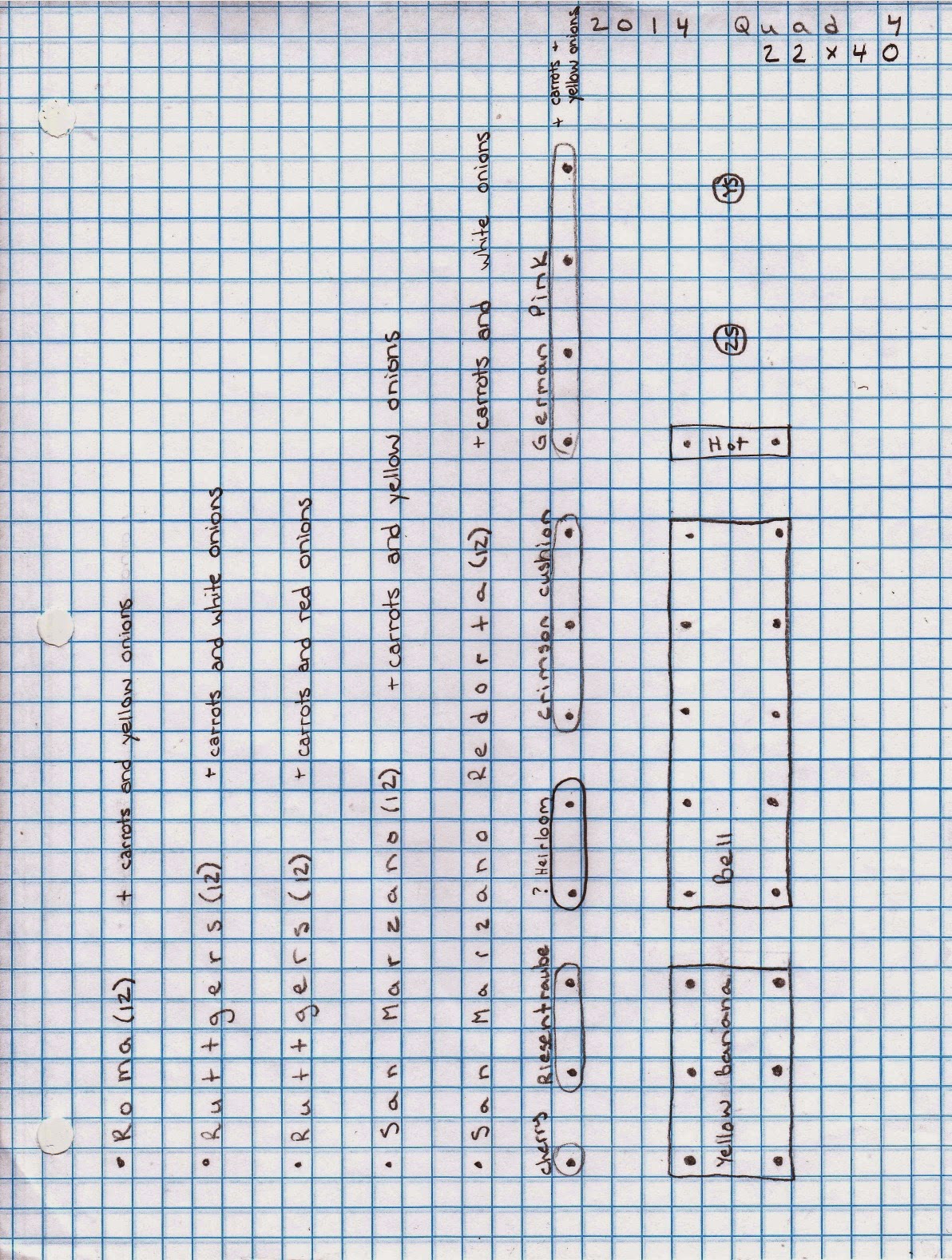
Last but not least, is quadrant 4.  Tomatoes seem to take up most of this quadrant, but there is much more going on in here than tomatoes.

This year I am planting 72 tomato plants which will produce just about the right amount of tomatoes for much fresh eating and canning for our family of 6, if the growing season cooperates.  I have planned their rows according to height (except my last row) and sun exposure, with the tallest plants being planted east, to avoid shading out of smaller growing plants. When I plant my rows of tomatoes, I put a t-fence post on either end of the row and one in the middle.  Up and down these posts I stretch fencing wire, and I tie and train my tomatoes on these wires as they tomatoes grow.

It has taken me a decent amount of experimenting to come up with a combination of tomato plants to serve our eating and canning needs, but I think that I finally have it!

On the west side are my Roma tomatoes.  These are not my favorite sauce tomatoes, but they do come on earlier than the San Marzanos (my favorite).  Planting these allows me to can some early spaghetti sauce, and they give me a back up if my San Marzanos have troubles. Next are the Ruttgers.  These are an earlier tomato, very prolific, and long lasting.  Much of my tomato juice and stew tomatoes come from these, which will be used as tomato soup, in stews and other soups, and to cook rice or noodles in for extra flavor. After the Ruttgers are my San Marzanos.  I LOVE these tomatoes.  They are smaller, but their sauce qualities make up for their size. They are an amazing sauce tomato with a low water content and great flavor.  They are a bit later, but once they are going they are very prolific. I have found that these are prone to blossom end rot in my garden, more so than the other tomatoes.  (Blossom end rot is caused by calcium fluctuations brought about by inconsistent watering. Last year, however, when many were battling blossom end rot, not even my San Marzanos had trouble.  I attribute it to a saving my egg shells through the winter, which I crushed and worked into my tomato rows, as well as having a nice layer of mulch around my tomatoes.)  After my San Marzanos, are the San Marzano Redortas.  These tomatoes are completely amazing in their massive size and sauce qualities, although I did struggle with them a bit last year which was my first year of growing them.  The tomato horn worms love these plants more so than the other plants (they like the regular San Marzanos too), some of the plants just didn't take off as well, and they were a bit later than the San Marzanos only giving me a short harvesting season.  The tomatoes I did get impressed me so much though, with one tomato producing enough for almost a pint of sauce, that I am going to give them a try again. I will make sure to give them an extra dose of our rich compost and keep a better eye out for those pesky horn worms. My last row is mainly my fresh eating row, with extras being canned for stew tomatoes or juice.  The cherry and Riesentraube are wonderful little tomatoes to snack on while gardening (for both myself and my kids).  The Crimson Cushion and German Pink had wonderful flavor last year and both earned a repeat spot. (As you might guess, the German Pinks were a huge hit!), and I have a couple spots open to experiment with new varieties, which one day might take over the spots of another.

Around the tomato plants I have a bit of companion planting going on.  Right within my tomato rows, between the tomato plants, is where I plant my onions.  They did very well last year being planted this way. Also, nestled right up alongside the tomatoes and onions are my rows of carrots.  They also did wonderfully last year.

In this quadrant I also have my peppers for salsa, freezing, and pickling. In addition, I have one zuchinni plant and one yellow squash plant, which provide sufficient squash for many breads, soups and meals - either fresh during the summer or grated and dehydrated to be used throughout the winter months.


What Do Groceries Look Like Throughout the Year?

As for feeding our family of 6, including lunch since we homeschool, I budget an average of $35 per week for our food groceries. That gets us 3 gallons of milk, cheese for our pizza night, rice, beans, noodles, oat groats or rolled oats for breakfast, and wheat berries to grind for flour, along with a few other random things. (The oats and wheat berries come in bulk from an Amish store by where I grew up, along with my bulk spices.) 

Last year I canned/dehydrated/froze 522 quarts of food, with 445 quarts coming from our farm. (We had fruits and some extra veggies given to us locally.) We also filled our storm shelter/root cellar with root vegetables, squash, and gifted apples.

I cook almost everything from scratch and don't make a lot of treats or fancy meals, but we eat well from what we have preserved. For our meat, we eat mostly shanks and hocks that I can from our farm, with random other cuts that are end portions or that get packaged funny, which we won't sell. We also enjoy our eggs sporadically when they don't all sell. When they do, we go without. Hopefully we will have a milk cow in the next couple years as I am in the process of training/taming some heifer calves.

As I mentioned, gardening to help feed our family from the farm is comparable to having a job.  Many summer days I would prefer to be hanging out with friends at the lake, sipping lemonade or reading while watching the kids play in the yard, or doing a bit more traveling and visiting.  But my garden is a job that keeps me at home with the kids, and it's a way to support my husband - and for that I am blessed.


Follow The Beginning Farmer's Wife on Facebook for additional personal peeks at building a family farm.

Tools of My Trade
This book has been a wonderful resource to me on companion planting in order to make the most of my garden space and grow foods without the use of chemicals. It details good and bad companions, how various plants work together for increased flavor, productivity, and pest control.  It includes information not only for the vegetable garden, but also for companion planting with fruits, nut trees, ornamental plants, and much more. Copies of this book can be found used or you can purchase a new copy from the link provided.

Much of what I preserve is pressure canned in order to kill all bacteria in low acid foods that would cause dangerous foodborne illnesses. They can be safely canned by using the recommended times and pressures given for your altitude. I have a couple older Mirro pressure canners given to me that work wonderfully, and my mom has a newer one that she loves as well. If you do some asking around, you might find someone who has given up canning and has one available, or you can look for one like the one pictured below. It should hold around 9 pint jars or 7 quart jars.

Friday, March 7, 2014

Crooked Gap Farm Snapshots :: Beauty Within the Thorns

I love this little bird's nest my son and I came across in the brambles today while working on a school project.

It is a reminder of the seasons that each have their place, as well as a reminder that even within the tangled thorns in life there could be a beauty hidden that brings forth newness and life.


Follow The Beginning Farmer's Wife on Facebook for additional personal peeks at building a family farm.

Related Posts Plugin for WordPress, Blogger...